Artist Talk: Arishima Msueum

Shimizu Toshio (Art Critic) × Date Motoshige × Season Lao
Date : 2026.2.14
伊達 元成, 清水 敏男, Season Lao
Kiyoe Gallery Arishima
Niseko, Hokkaido, Japan
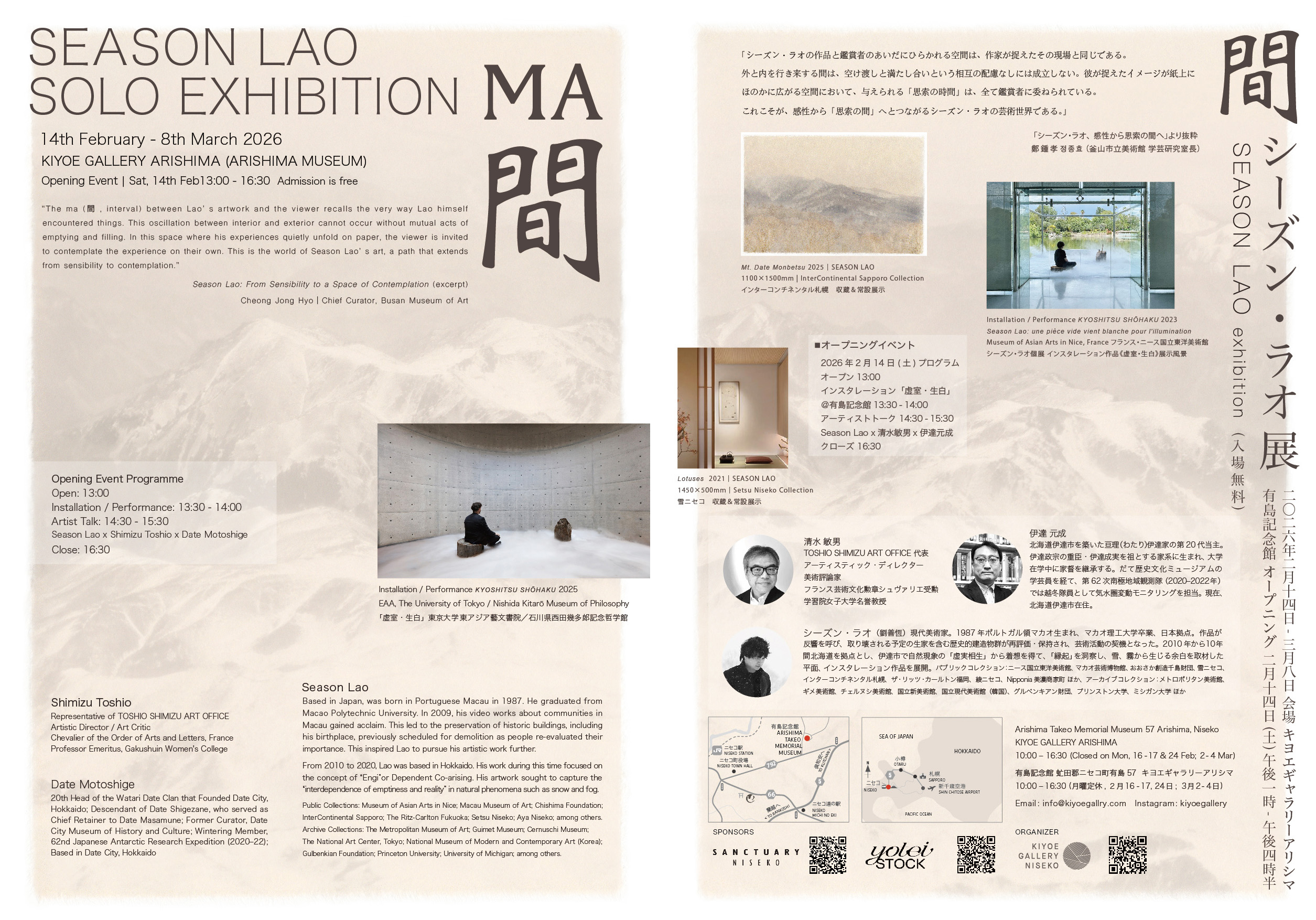
Immanent Landscape — Between Fūdo and the Sense of the Sacred
By Motonari Date (Former Curator, Date Historical and Cultural Museum, 20th Head of the Watari Date Family)
The landscapes of Date City that appear in Season Lao’s works are not merely geographical records. Within them, layers of time accumulated in the land quietly overlap with traces of human life.
Date City in Hokkaido is a place shaped by vibrant history. In this place, where nature, human activity, past, and history and the present all meet in multiple layers,my ancestors of the Watari Date family began developing this land about 150 years ago. Their name eventually became inscribed into the place itself in the name “Date.”
The region has been formed by the continuous practices of agriculture and fishing and the lineage of the Date clan, which has made the city their home for more than eight hundred years. The clan’s rich samurai culture lends a particular depth to the landscapes of this region. A landscape, therefore, is not merely a natural view; it is a site that acquires meaning through the continuity of human life.
Thus, what Lao’s works evoke is not simply nostalgia. Rather, they bring forth a sensibility that emerges through the changing seasons and the solemn transformations of weather. Mountains, trees, flowing water, the animals that inhabit them, and the human lives sustained by these elements appear not as separate fragments but as a single interconnected whole.
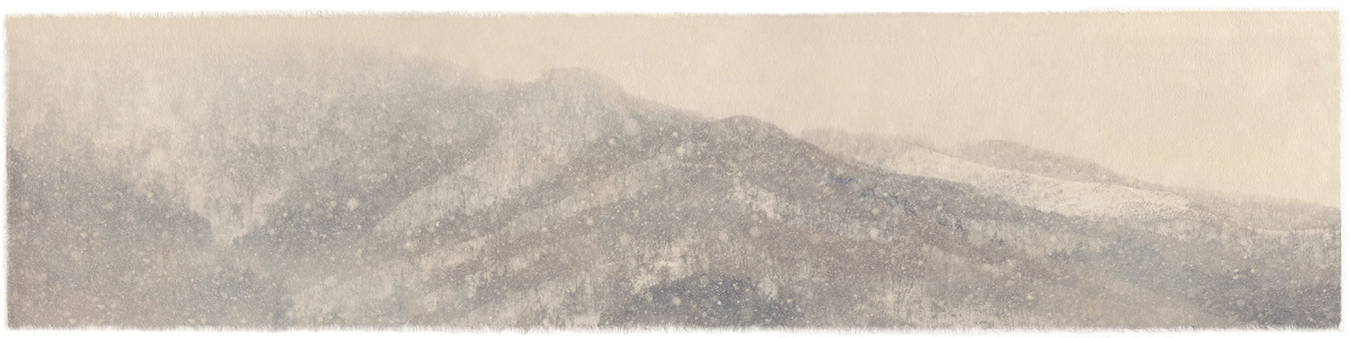
What is particularly striking is the sense of the sacred does not arise directly from the grandeur of nature itself. The sacred emerges when nature and human activity encounter one another, and through their continued relationship.
From 2021 to 2023, I lived at Showa Station in Antarctica as a member of the Antarctic research expedition. I conducted research on carbon dioxide and radioactive substances while also observing various phenomena related to global warming. The station lies far from the bases of other nations, resulting in there being no other people besides our team within a radius of one thousand kilometers. The air contains almost no dust or water vapor, making the atmosphere so transparent that the geological layers of mountains sixty kilometers away can be clearly seen.
In a place such as Antarctica, where nature is overwhelmingly vast, fūdo—a lived landscape shaped by climate and culture—does not easily emerge where continuous human life is absent. Unless a relationship between nature and human beings accumulates over time, the presence of the sacred does not naturally appear. What is lacking is not the scale of nature, but the time of relationship.
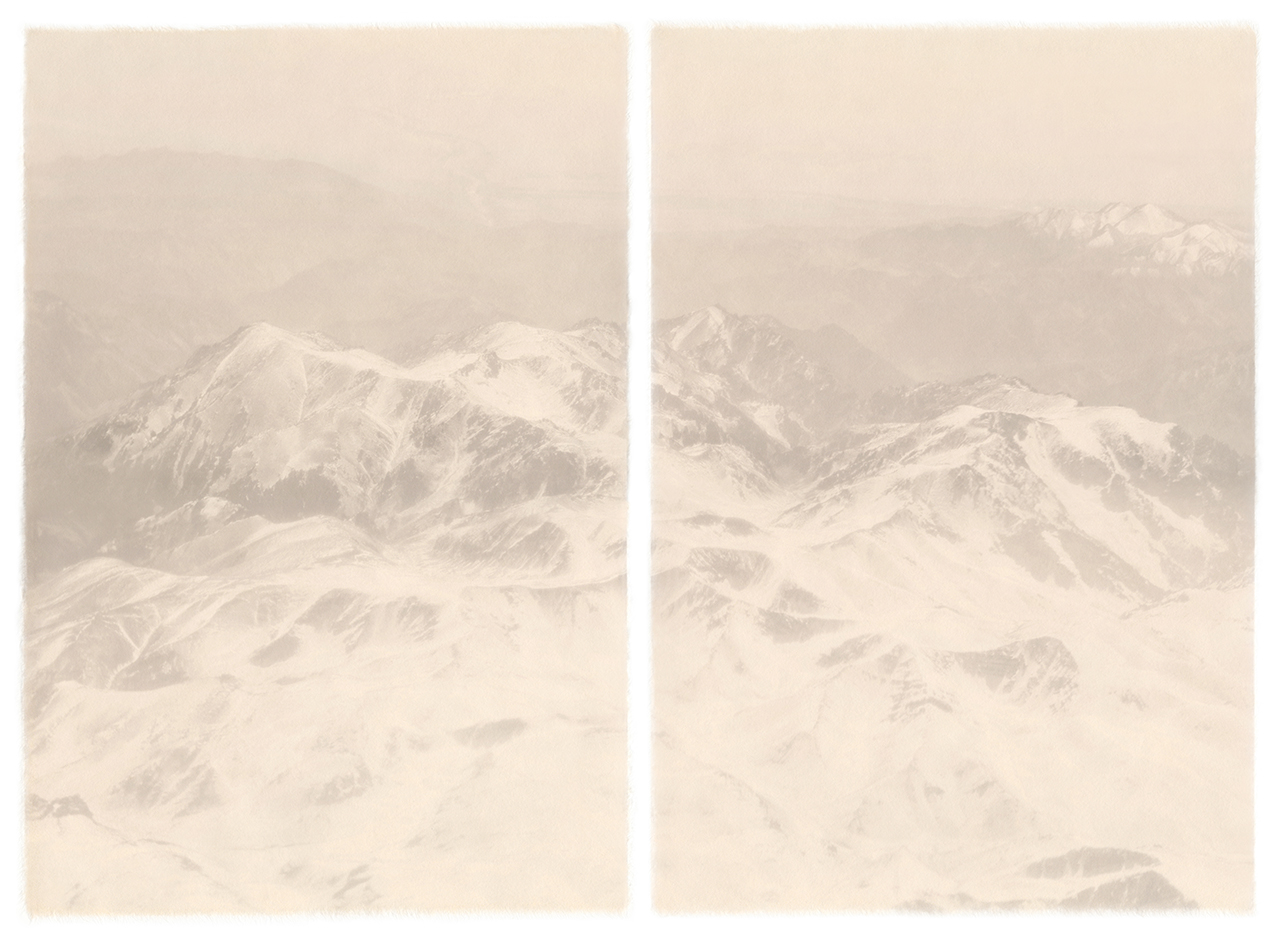
When standing before Lao’s photographs, I experience more than the familiarity of recognizing the scenery itself. I sense a deeper resonance tinged with a certain sacred quality together with the overlapping lives of the people who inhabit this region. What appears between the work and the viewer’s emotion is a moment in which the cyclical changes of the Earth’s seasons intersect with the temporal rhythm of human life.
This sensibility also resonates with the animistic view of nature deeply rooted in Japan. The capacity to perceive spirituality in objects and landscapes cultivates both reverence and awe toward nature, while sustaining an ethical relationship with it across time. Such layers of ethical sensibility seem to quietly underlie the background of Lao’s work as well.
The theme of ma can also be seen in Lao’s work where it is not only a sense of spatial emptiness but as a structure of time. In Shinto thought, Naka-ima refers to the present moment that connects past and future—a nodal point through which time is transmitted.
Usually, photography fixes a moment. Yet in Lao’s works this fixation does not suspend time; instead, it becomes an occasion that makes us aware of the flowing temporality of Naka-ima. Viewing is then transformed into something more than the mere act of looking at a landscape. It is an act of observing the emotions that arise within oneself, together with the enduring time that lies behind them.
By Toshio Shimizu (Art Critic / Artistic Director)
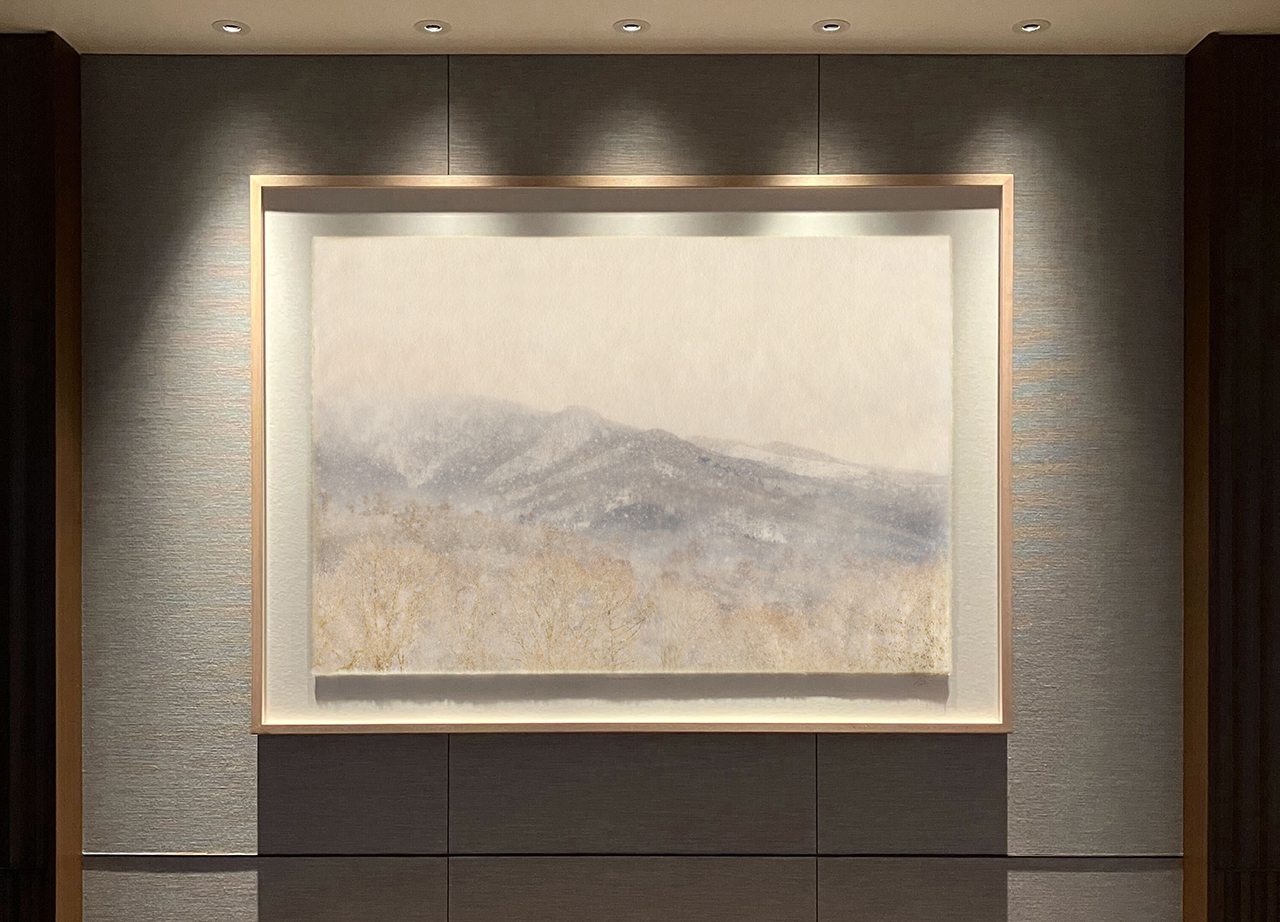
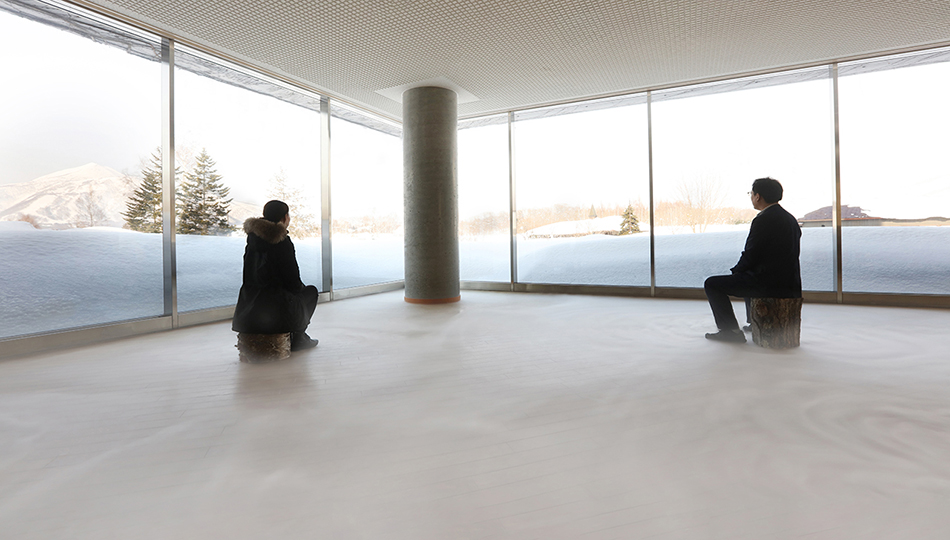
Season Lao’s installations quietly transform space itself. Inside the exhibition environment—often framed by snowy landscapes outside—viewers sit on the floor, placing themselves at the same level as the works. At that moment, the work ceases to function as a purely visual object and instead becomes an environment that envelops the body.
Such an experience invites us to reconsider the concept of ma—a relational interval through which perception and presence emerge.
In 1978, the architect Arata Isozaki organized the exhibition MA: Space-Time in Japan in Paris. There, ma was primarily presented as an architectural and physical space—an actual void that appears between artworks or structures.
Yet ma cannot be reduced to a purely physical notion of space. While space is visible, time is invisible. Nevertheless, we undeniably experience time.
In 1998, during the planning of a Japanese contemporary art exhibition in Shanghai, the possibility of presenting ma as a concept of time was explored. In this context, two forms of temporal awareness within Japanese culture became apparent.
One is Zen time, which transcends ordinary reality and tends toward the cutting off of time. The other is repetitive time, exemplified by the practices of Jōdo Shinshū Buddhism, where the daily recitation of Namu Amida Butsu accumulates as a continuous experience of time. This duality can also be seen in Japanese art. An example of an artist who embodies transcendental time is Hiroshi Sugimoto, while Nobuyoshi Araki is an example of one who visualizes repetitive time.
In Season Lao’s work as well, time is not represented directly but suggested through movement and fluctuation. Landscapes and objects are visible. Yet behind them exists an invisible layer. What appears there is ma that exceeds physical space.
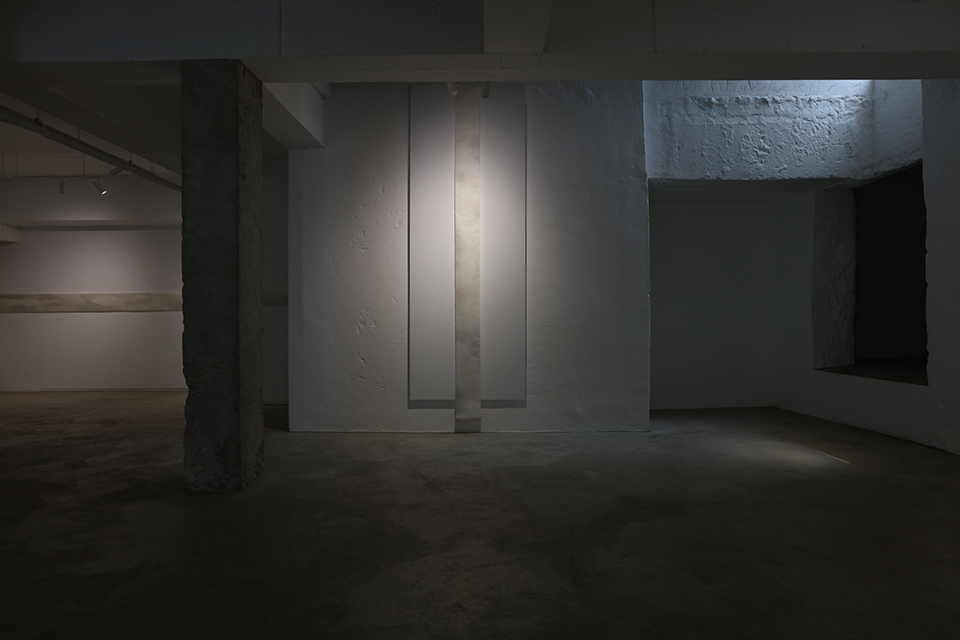
Another important element is the sensation of Qi. In East Asian landscape painting, mountains are not merely scenery. They are believed to emit Qi, and when such a painting is placed within an interior space, the energy of the mountain is thought to fill the room. Viewing, therefore, is not the act of observing an object from the outside, but of placing oneself within the circulation of Qi.
Within Western aesthetics, artworks have often been positioned as visual objects separated from the viewer. In East Asian art, by contrast, one finds a relationship in which viewer and work share the same experiential field on a spiritual level.
Season Lao’s installations exemplify the East Asian view. The viewer does not simply look at the work, but enters into it. One becomes enveloped by the work and placed within the flow of time and Qi.

This sensibility also resonates with the animistic worldview deeply rooted in East Asia. Nature is not an absolute force opposed to humanity, but rather a field of circulation that also brings forth blessings. Within water, light, and the changing seasons, humans and nature remain interconnected.For this reason, an artwork is not merely an external object. It becomes a shared environment.
A similar structure can be found in music. The experience of music emerges not from sound itself but from the interval between sounds. While modern Western music has developed a clear separation between performer and audience, Japanese perception has often emphasized a mode of listening in which the listener places themselves within the interior of sound.
Thus, ma cannot be understood simply as empty space.Qi, likewise, cannot be reduced to a symbolic concept.Both express a fundamental sensation that we are always already inside something. Season Lao’s works guide viewers into this interior. We do not stand outside the work; rather, we are already placed within a field where time, space, and energy intersect.

rondins, logs, video Creative Center Ōsaka – Chishima foundation collection
Date Motoshige
20th Head of the Watari Date Clan that Founded Date City, Hokkaido; Descendant of Date Shigezane, who served as Chief Retainer to Date Masamune; Former Curator, Date City Museum of History and Culture; Wintering Member , 62nd Japanese Antarctic Research Expedition (2020‒22); Based in Date City, Hokkaido.
Shimizu Toshio
Representative of TOSHIO SHIMIZU ART OFFICE Artistic Director / Art Critic Chevalier of the Order of Arts and Letters (France), Professor Emeritus at Gakushuin Women's College.
- Artist’s Note
The origin of my practice lies in a snowstorm I experienced in Date City, Hokkaido, in 2009. At that time, I had come to Date for the first time for a two-month internship. One day, while living there without even understanding the language, I encountered a snowstorm the likes of which had not been seen in twenty years. Visibility was zero.. Yet alongside fear, I also felt a strange sense of reassurance and nostalgia.
What I experienced then was not absence, but a sensation in which everything was evenly enveloped—a state I later came to understand as Natural Emptiness.
This experience gradually crystallized into my work. The sensation that arises when fog or snow appears is a bodily experience that precedes theory. It became the co-emergent origin of my practice makingDate City a foundational layer of my practice.
In this exhibition, the installation does not attempt to represent something. Rather, it accepts the conditions of the place—the Arishima Takeo Memorial Museum—and allows the desired state to emerge within it. The work changes according to its relationship with the site and its surrounding environment.
Hookaido Projects
Related links :