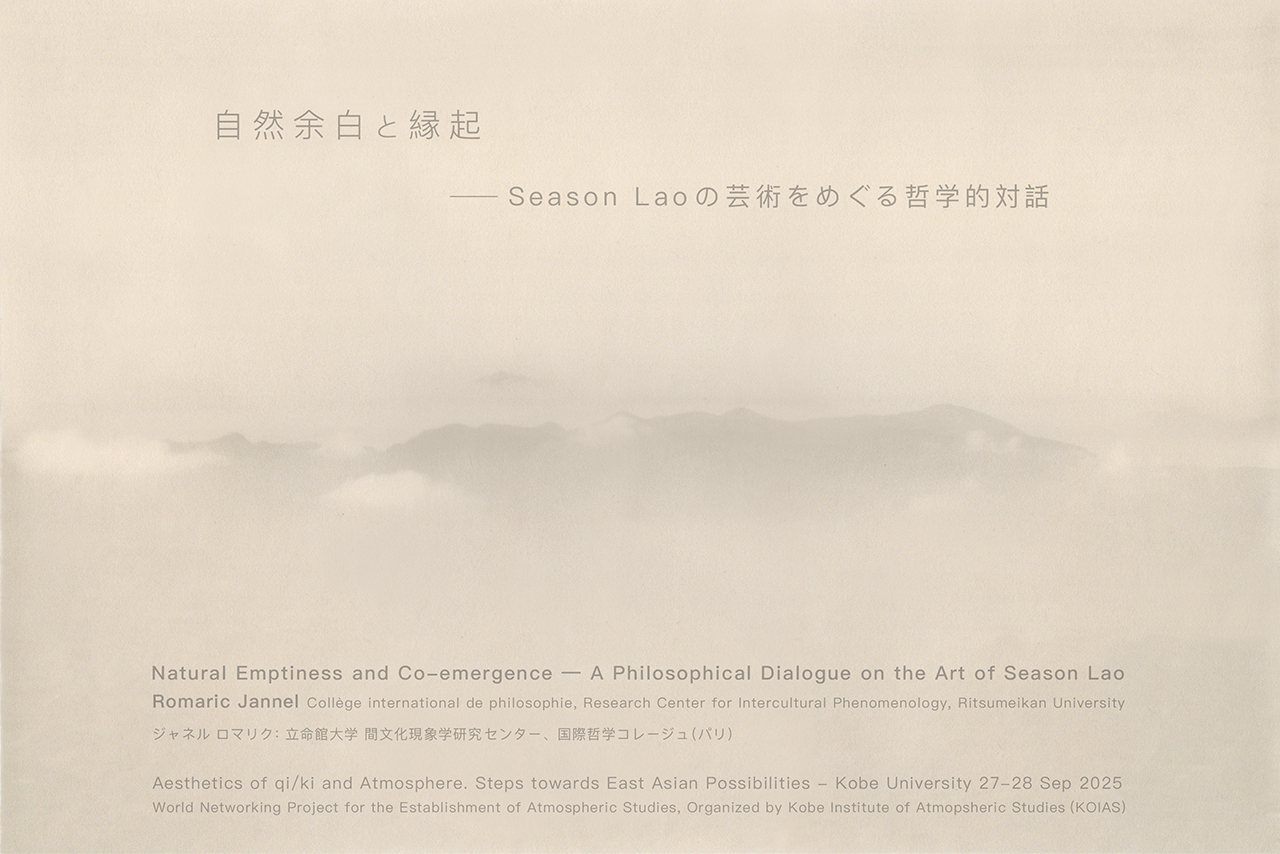
Art criticism : Natural Emptiness and Co-emergence — A Philosophical Dialogue on the Art of Season Lao
Romaric Jannel, Collège international de philosophie
Date : 2025.9.27 – 28
City : Kobe, Japan
Aesthetics of qi/ki and Atmosphere. Steps towards East Asian Possibilities - Kobe University 27-28 Sep 2025
World Networking Project for the Establishment of Atmospheric Studies, Organized by Kobe Institute of Atmopsheric Studies (KOIAS)
Romaric Jannel, Collège international de philosophie, Research Center for Intercultural Phenomenology, Ritsumeikan
My aim today is to think with Season Lao’s practice—his gei-dō 芸道—rather than simply present it. I will argue that his work invites us to reopen three philosophical issues:
-
1.How agency is distributed across human and nonhuman participants.
2.How space—kukan (空間), yohaku (余白), and ma (間)—forms what can appear.
3.How arising is structured in the Buddhist notion of engi (縁起), co-emergence.
Methodologically, I begin with classical bivalence and mark where it becomes inadequate. Where representation obstructs appearing, I shift to an inverted tetralemma (neither → both), which leads to the suspension of reified predicates, allowing appearance to occur as co-emergence. In Lao’s installations and images, fog and snow are not ornaments but operative conditions. Here, “image” functions as enactment: a configuration of conditions that renders properties perceptible. Paper, fiber, light, sound, and humidity do not merely support a form; they co-produce its appearing. Entering such a work implicates us in an atmosphere that recasts the subject–object opposition and reframes how meaning arises.
1. Art as a Grasp of Human and Nonhuman Nature
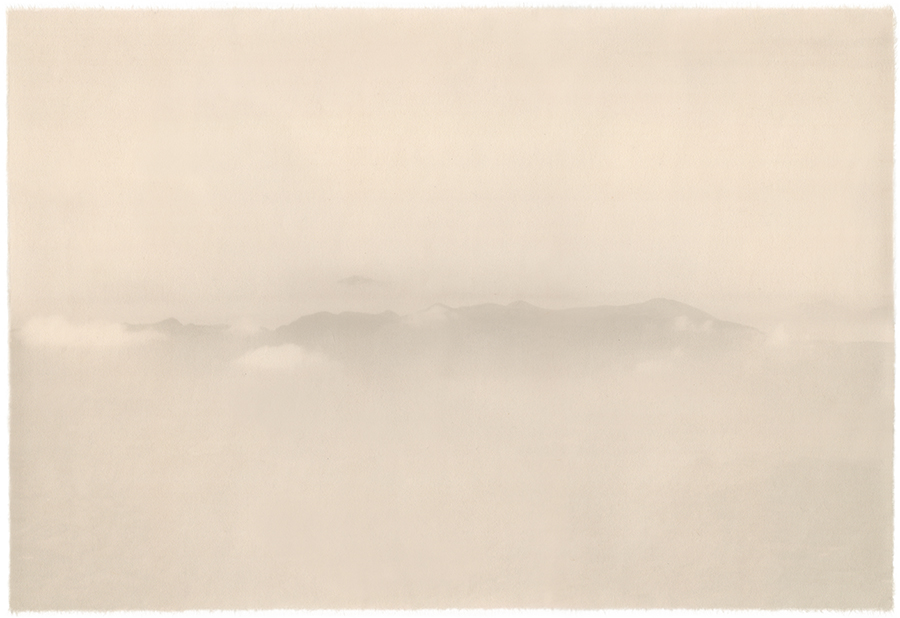
A familiar picture treats art as a human transaction: the artist produces, the viewer receives, and nature is a topic or a backdrop. Lao’s work questions such a view. Stand in a fogged room and fog behaves: it moves, breathes, shapes perception. The same thing happens with snow. These are processes through which the field reorganizes. Therefore, agency is not merely a matter of individual forces; rather, it implies a systemic transformation.
Bruno Latour’s vocabulary helps here: things are not mute “objects” but actants—participants that translate forces and delegate actions. Landscape, sunlight, winter cold: each reconfigures a situation. Seen this way, Lao’s practice does not represent a prior content; it orchestrates a multi-agent field in which “form” is a stabilized pattern of interactions. The texture of the kōzo paper, the ambient humidity, the location, the time of day, and the artist’s attention all function as factors that shape the artwork.
Non-agency here is not a lack but a positive condition. Lao’s refusal to overdetermine—leaving space, accepting chance, welcoming the unexpected—is not abdication. It is the deliberate provision of conditions under which phenomena articulate themselves. Leaving an interval is an ethical-aesthetic stance: preparing conditions that allow variable patterns to stabilize without overdetermination. Consequently, the viewer is not a detached consumer. Lao gives a concrete grammar to simple positions: agency is distributed, art relational, “nature” a collective composition.
2. Space (空間), Empty Space (余白), Interval (間)
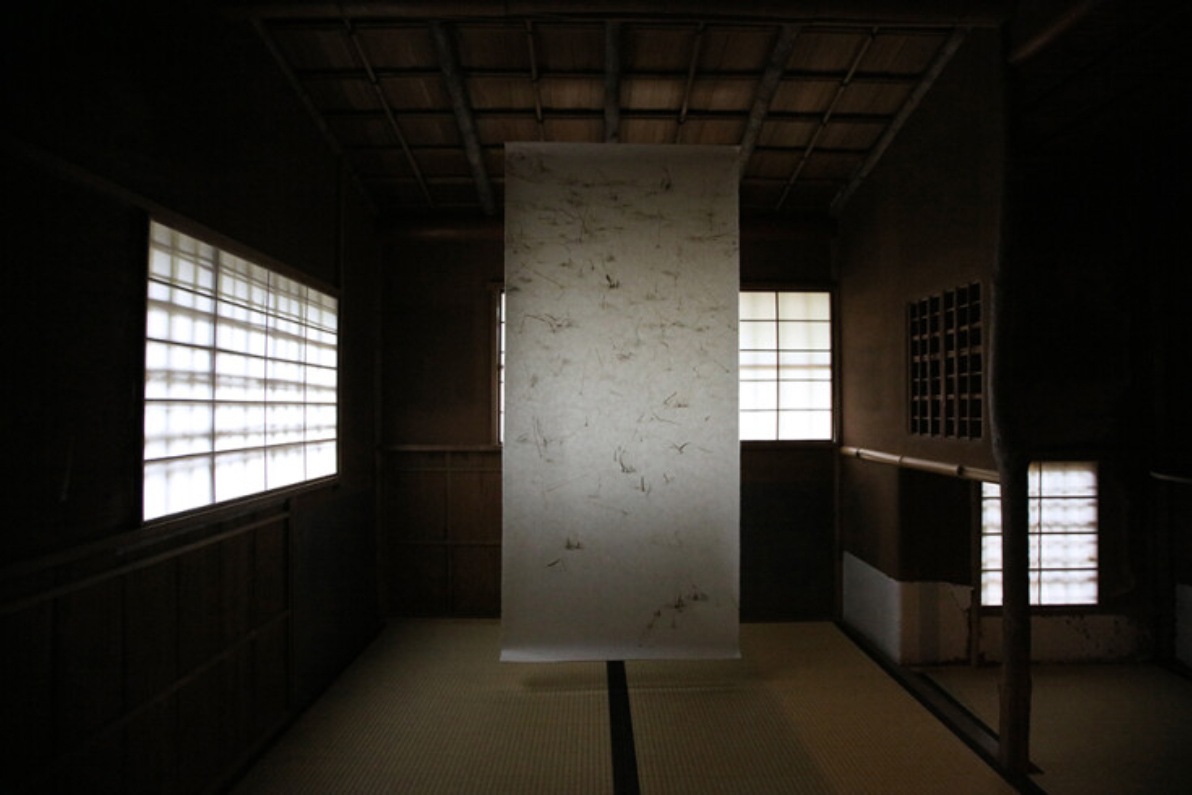
Permanent Installation at Nipponia Mino Merchant Town
We often treat space as an empty container awaiting forms. Yet, in Japanese aesthetics, space is formative.
-
Kūkan (空間) names the lived field in which things and people exist. Emptiness here is not a lack but operative spacing: enabling constraints that let configurations form and reform.
Yohaku (余白) is translated as “blank,” “margin,” or “empty space,” but it is not mere absence. It is a productive margin of withdrawal that provides degrees of freedom. “The empty” expands what the situation allows.
Ma (間) is an interval or, more exactly, an articulated “between.” It is the joint where co-determination becomes perceptible without reduction to representation.
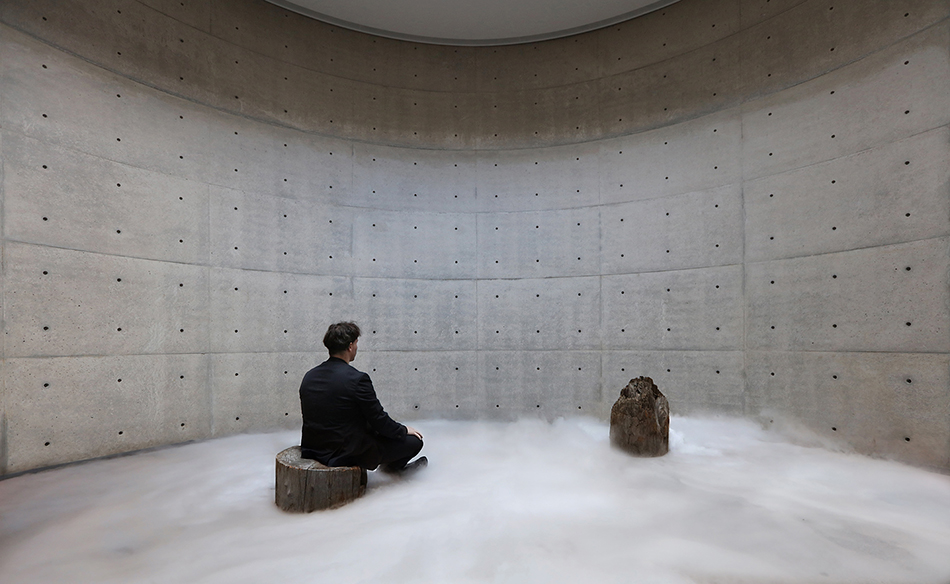
Nishida Kitarō Museum of Philosophy, organized by the East Asian Academy, University of Tokyo 2025 | Play Video
A tea room makes this concrete. Its smallness, its quietness, its low entrance that calls for a bow, and its windows that open only after tea are not décor but the framing of an atmosphere fit for a singular event. Conditions set what may or may not occur. Lao works with the same logic. In Kyoshitsu Shōhaku, fog disrupts the boundaries between walls and floors, rendering the room an expanded interspace. Cold air rising from the floor modifies the room’s tactile and visual qualities. The same light no longer produces the same sensation as temperature changes.
Philosophically speaking, this changes the relationship between subject and object. In the modern picture, a conceptual wall separates an active subject from a passive object. Nishida’s early “pure experience” marks a phase before such division, where knower and known are not yet opposed. Lao’s rooms stage this pre-differential dimension without collapsing difference: in the notion of ma, subject and object are joined without identity, and precisely in virtue of their non-identity they can affect one another. Rather than positing an observing subject facing an object, perception is an interweaving—“un entrelacs”—in which the visible arises through background constraints. You cannot stand outside Lao’s works; you are inside a configuration co-composed by architecture, weather, materials, and attention.
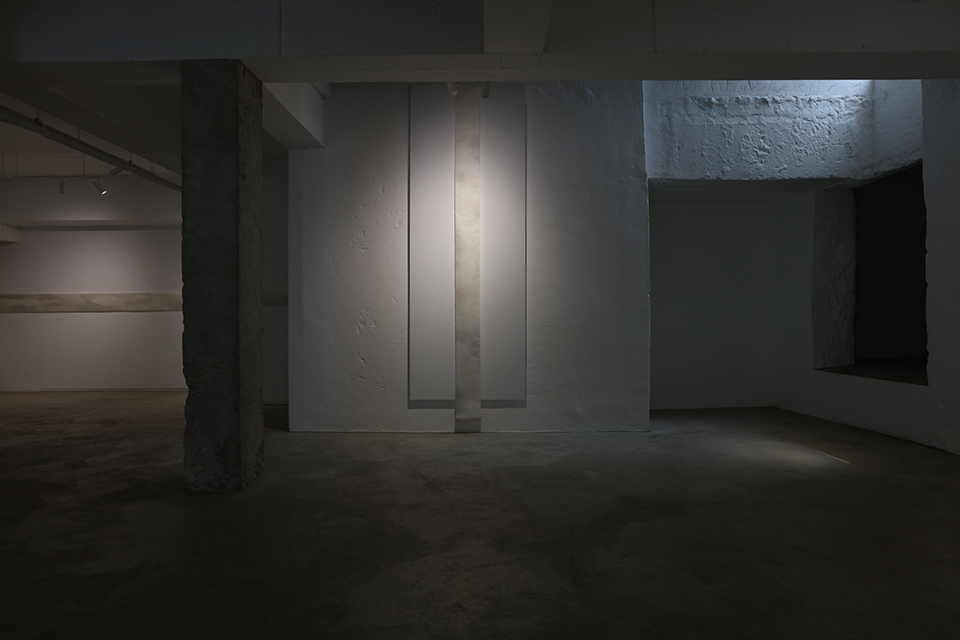
There is an ethical dimension here. Rather than a catalog of rules, ethics is a structuring of full and empty. Spacing is the shared condition for seeing and acting. “Space” does not have to be physical; it is any interval that makes room for spatiality, temporality, and psychological stability.
3. Engi (縁起): Co-Emergence and Natural Emptiness
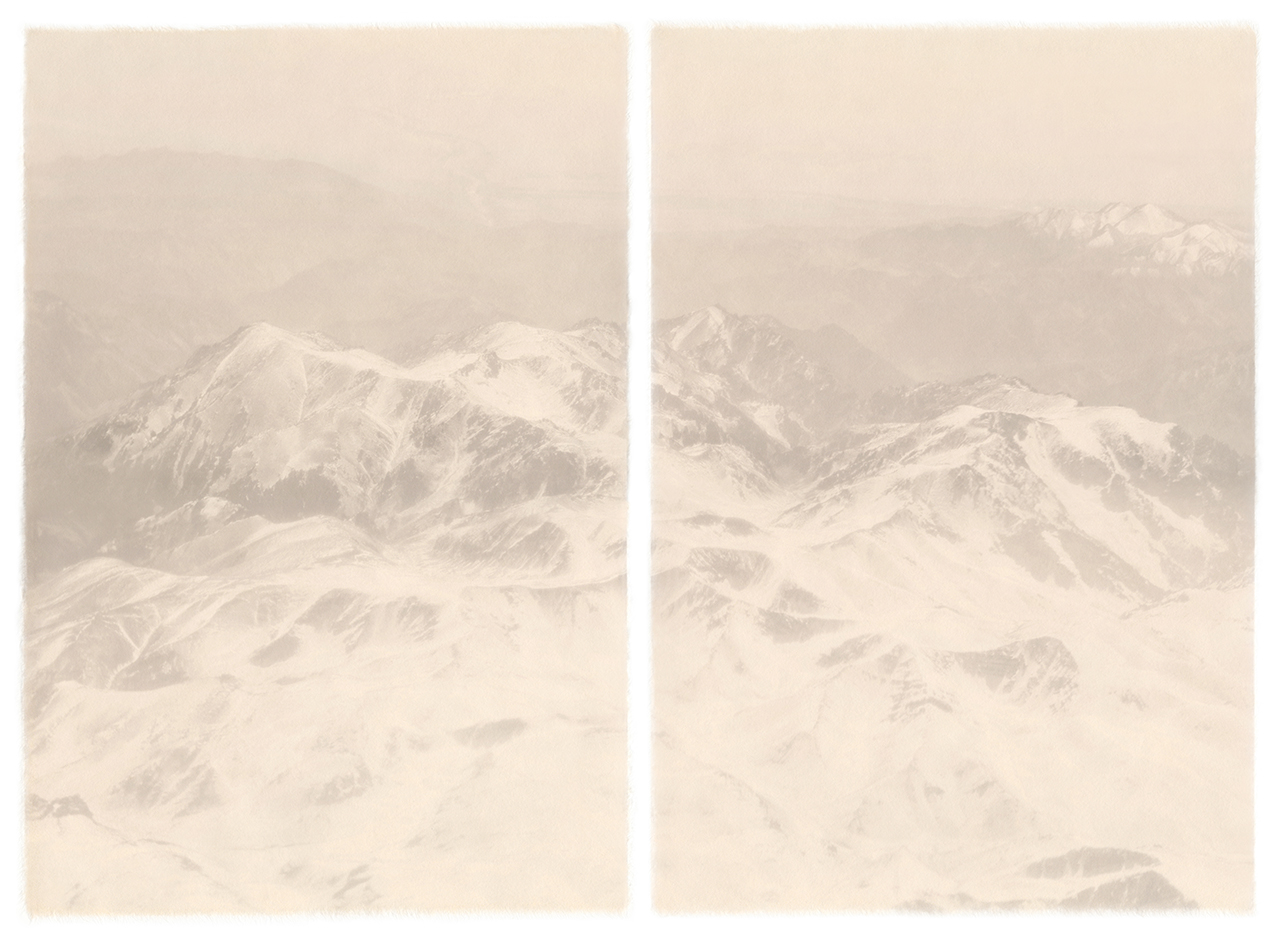
Engi is often translated as dependent co-arising. In Buddhist philosophy it names the fact that nothing exists by itself. Every entity, event, perception, or thought arises through conditions and ceases when they withdraw. To call something “empty” (śūnya) denies independent essence. It affirms relational realness as covariance among conditions across contexts.
Nāgārjuna radicalizes this through the tetralemma: is; is not; both; neither. The point is not the paradox itself, but rather, the solution to the problem of absolutized predications in a conditioned world. Emptiness names relational realness. Developing this line, Yamauchi views causality as co-emergence, considering each entity in relation to the others. Necessity appears as a special case. More often, conditions are stabilized through negotiated determinations.
We can understand Lao’s work through engi. Snow and pine do not preexist their encounter as finished items that then merely “meet.” In a given configuration, snow makes pine visible as pine and pine makes snow visible as snow. Fog does not simply layer onto a mountain; it belongs to the mountain’s mode of appearance. Natural phenomena—and the perceptions arising in consciousness—are processual.
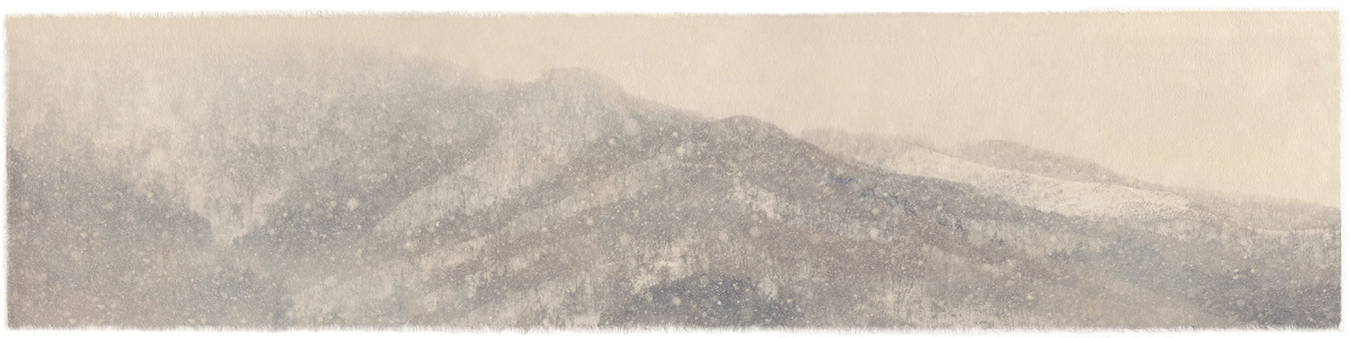
Here the inverted tetralemma clarifies Lao’s method. Take the pair “fog reveals / fog conceals.”
- If we affirm that “fog reveals,” we risk overlooking its ability to conceal.
- If we deny that “fog reveals,” we negate its disclosive power.
- The twofold negation (neither…nor) leads to the suspension of the reified predicate. In and of itself, fog is neither revealing nor concealing.
- The twofold affirmation (both) becomes insightful as it suggests that revealing and concealing co-arise from conditions.
This is not wordplay. It is a practice of attention: appearing sometimes depends on releasing fixed predicates.
The ethical consequence follows. If phenomena arise through conditions, action is never solitary. To act is to modulate a feedback-rich network. Small gestures matter because conditions are responsive; responsibility appears because effects connect. Acknowledging engi means protecting the delicate equilibria that allow things to happen, including what was not intended. What seemed like “empty possibilities” or “silence” actually constitutes a grounding compound of experience.
Conclusion: Middle-Voice Wonder
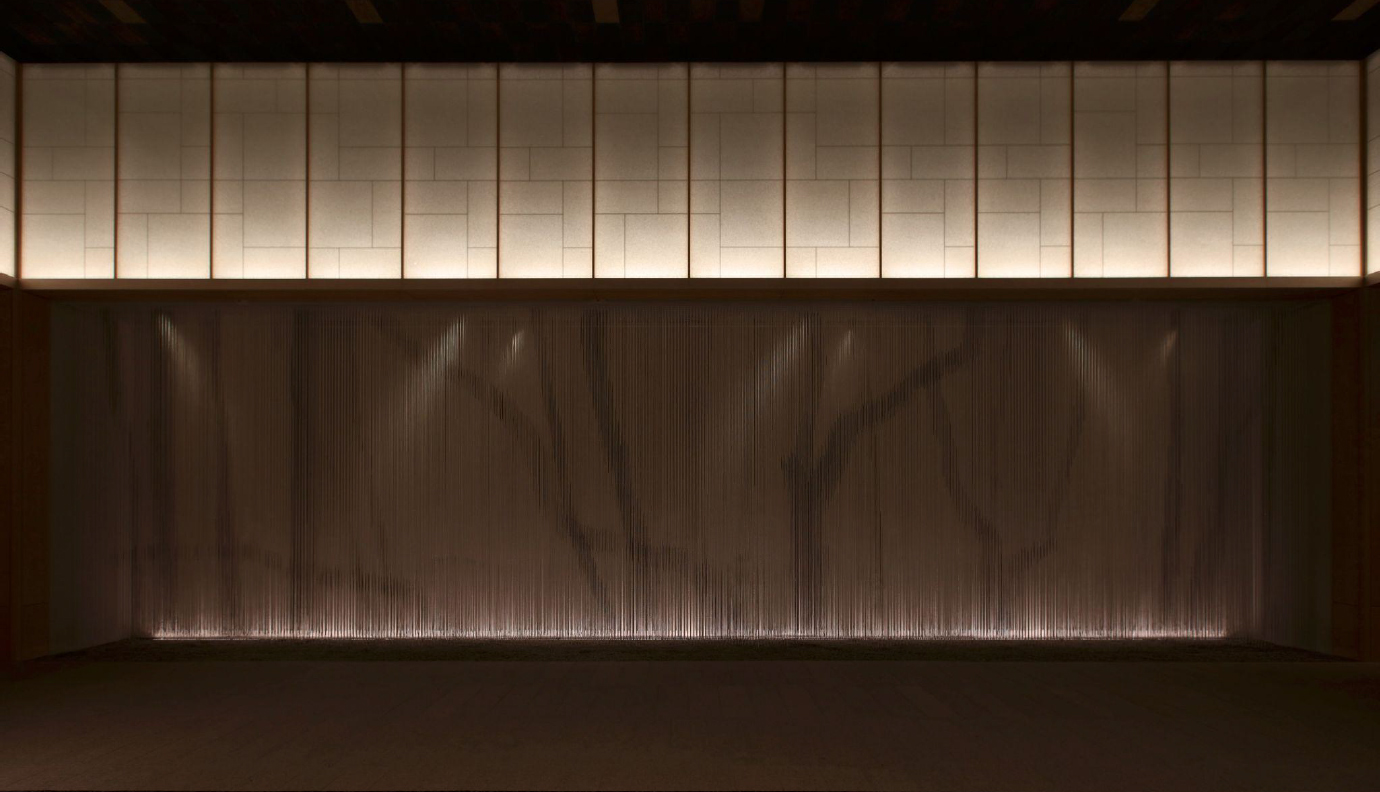
Ink on string 980×270 cm | Permanent Installation at the Entrance of The Ritz-Carlton, Fukuoka
I have argued three points. First, Lao’s work shows distributed agency: human and nonhuman actants co-compose reality. Second, space, margin, and interval are active. They shape what can appear and train attention. Third, engi reworks causality: nothing stands alone; emptiness names relational realness.
Beyond the gallery, wonder—the beginning of philosophy—is not only a response to entertainment; it is heightened attention that the work allows. In fog, one feels that emptiness opens what can happen and that space lets presence show. The fitting stance is the middle voice: conditions operate through us as we choose to act or refrain. The conclusion is a call to let logic, metaphysics, and ethics learn from emptiness rather than from overload. This would allow the interval that joins yet distinguishes to manifest, enabling participants in a shared reality to appear and act together.
Trackback from your site.